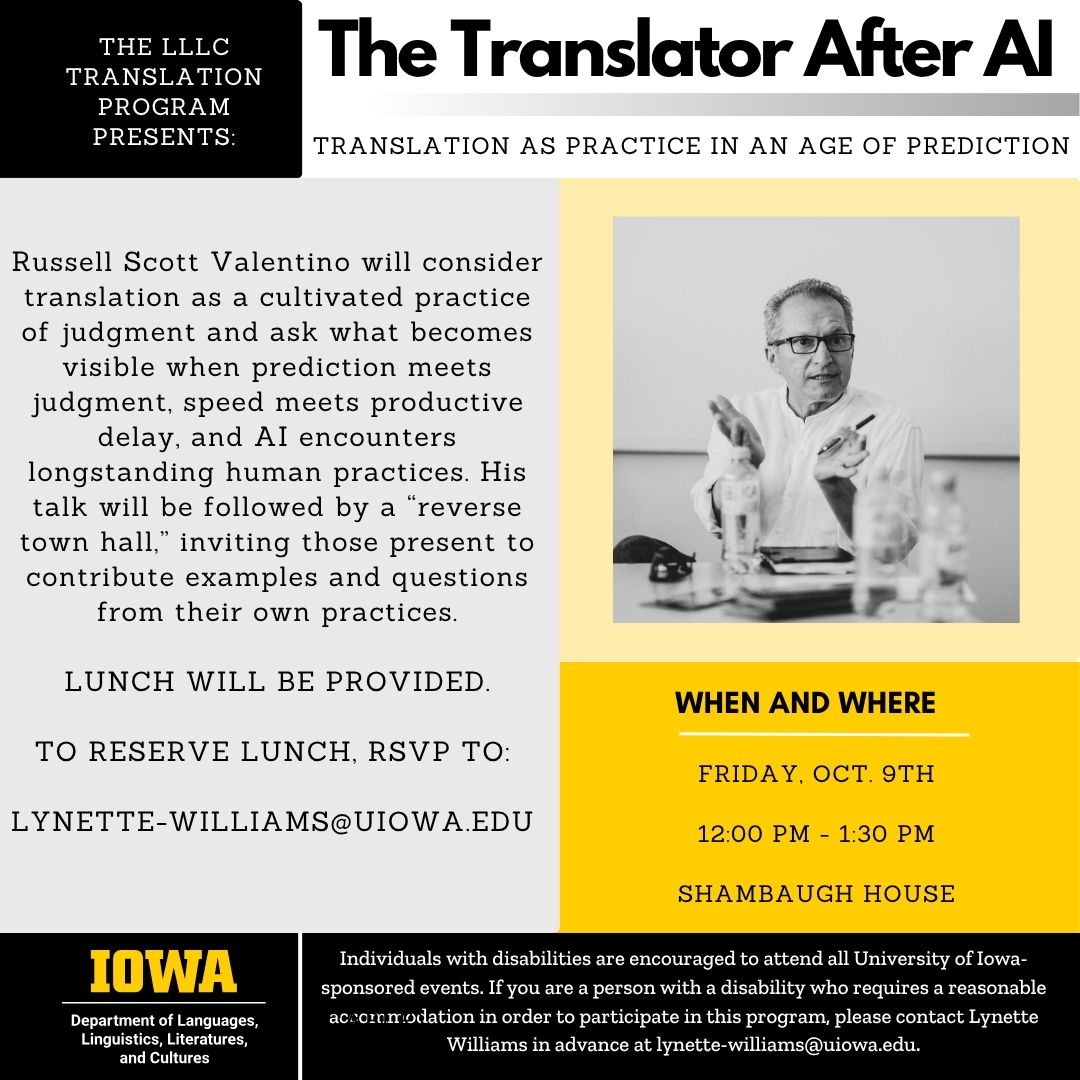
My Iowa trip (see pic) was enlightening in all sorts of ways, and I’m still processing as I prepare for the upcoming ALTA meeting in Portland. Fall is like this.
In addition to the advertised event, there was an informal gathering at the Obermann Center for Advanced Studies, for a group of people thinking about AI and translation. In that discussion Jan Steyn pointed out that my two projects, which I’ve been describing as siblings, seem to be running on different time scales: Sea of Intimacy on a very long one, The Translator after AI on one that’s shorter, faster, and apparently more urgent.
He’s absolutely right, and it’s helpful to make it explicit. Sea of Intimacy not only relies on that slower pace, it encourages it — don’t worry, we’ll get there eventually. The Translator After AI feels like we’re already behind. One of my writing goals has been to make the first if not more urgent then at least more applicable to our current moment, and to make the second less topical and less narrowly focused.
In that spirit, I note that mathematicians, too, are struggling in their interactions with AI. “Why One of the World’s Greatest Mathematicians Is on a ‘War Footing'” (by Elizabeth Bumiller, NY Times, Oct. 16, 2026) reports on the developing conflict of Terence Tao with OpenAI. And while there are plenty of differences in the particulars, the general situation bears remarkable similarities to the one translators have encountered over the past several years. We can learn from each other.
My sense is that both groups are facing a core difference in the approach to the activity itself. An Oct. 13 NY Times piece suggests as much in its title: “When A.I. Comes for Your Purpose in Life.” Purpose is important but doesn’t quite get there. I’m wondering more about a distinction that is, in fact, pervasive in more than these two fields and is sending us racing in all directions without properly focusing on it.
The pervasive assumption that an activity can be adequately understood by specifying what it produces reflects what I have started thinking of as an outcomes ontology: mathematics produces proofs, translation produces target texts, writing produces prose, education produces competencies, or skills, or jobs, and so on. Once the output is specified, the process that generates it appears principally as a means to an end, and alternative processes can be compared by quality, cost, speed, and reliability.
AI provides a limit case for this way of thinking by enabling a separation of the output from human participation in the practice that historically produced it. Suppose the AI-generated math proof is correct and elegant, the translation accurate and fluent, the essay clever and well-structured. Suppose verification problems are solved — there’s no hallucination, it’s all correct. What, if anything, is lost if human participation in producing these objects approaches zero? That’s the limit case.
The question only looks nostalgic if we assume in advance that the purpose of a practice lies entirely in its product, its outcomes. But practices may produce other things along the way: capacities, habits, relationships, standards of judgment, ways of attending, even particular kinds of people. In some cases, moreover, the outcomes might be the by-products. The goods associated with the practice become difficult to see when the object at the end of the process is treated as the activity’s sole reason for being.
Machine-translation post-editing (MTPE) provides an instructive analogy. Translating and checking a machine-generated translation may yield equivalent products while remaining different activities. Anyone who’s ever done both can feel this difference, but how exactly remains to be articulated, and this requires an exploration of the practice as such.
Translating without the machine’s help is a lot like what the human mathematicians quoted in the Times article describe as their practice. Post-editing, like examining a proof generated by an AI, begins with a proposed solution, which means it skips over something. What exactly has been skipped?
Put differently, the prospect of getting all the outputs without the practice will help us to see clearly what the practice is for, what it has been for, and what makes it valuable for human practitioners.
###

