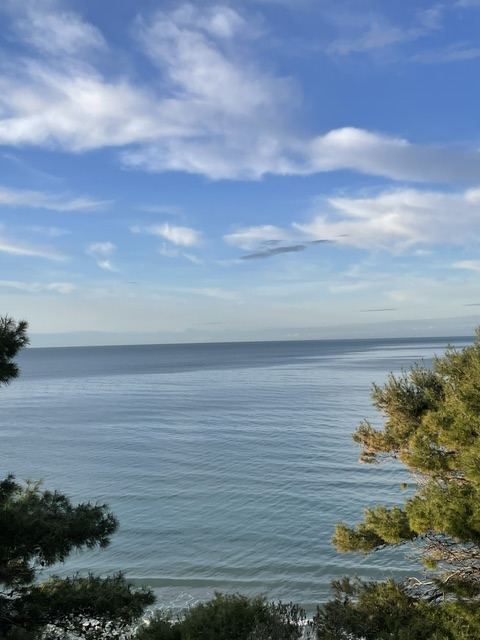
I stumbled across or — maybe better — waded into the notion of productive delay while writing about the Adriatic as a translational space. I was thinking about how things tend to be when you have to move in and through water, but also how connected it makes everything. Here’s a paragraph from early in Sea of Intimacy:
The sense of extreme proximity, however—I felt it even then—concealed something more than its claustrophobic first impression, that steamy pressing up next to one another that might encourage the donning of masks, real and figurative, as one exits and enters the door to one’s palazzo. The combination with water, an intimacy linked by liquid to other realms, felt somehow familiar. Delay was everywhere. The fluid borders seemed to serve almost as temporal buffer zones. It was a place that could not help but be old-fashioned. And something about this sluggish anachronistic mingling tugged at me, subtly at first and then more and more insistently.
I hope I figure out some of the why behind the tugging by the end of the book (almost there!). In the meantime, there’s that meantime, which is the delay itself. And it turns out a lot of productive stuff can happen in there. I’m not just talking about the regulation of traffic, though that too can be helpful. (Consider the Adriatic practice of quarantine, for example.)
I’ve tried out thinking about this slowing down in ecological terms, where the estuary has become my favorite metaphor: a slow, sloppy mixture that’s extremely rich in varieties of life, an extended in-between where time seems to slow. Estuaries are what Michael McCarthy, in his 2015 book The Moth Snowstorm has aptly called “the poor relations among landscape features” (77), the “intertidal ooze at the edge of the sea [that] is the richest in invertebrates of all habitats, able to hold in a single square metre thousands of tiny mollusks, crustaceans, marine snails, and marine worms” (50).
And at the other extreme, inevitably, I’ve thought of it in terms of the instantaneous responses of generative AI, where there’s no thought happening, only predictions and likelihoods of combinations. Very fast predictions and combinations. So fast that when an output is generated (passive voice on purpose), it can take you a long time to figure out the words. That doesn’t feel like productive delay to me. It feels like the need to catch up, which is very different.
Human translators are, of course, much slower than generative AI translators. (And yes, I just shifted from Sea of Intimacy to The Translator After AI. The two projects have been talking together for a spell now, and they seem to have much to say to one another.) There are obviously many other differences between human and AI translators, but speed is definitely one of the biggest. Sometimes human translators don’t even appear to actually start translating for a long time.
Michael Heim used to talk about “preparing the text,” by which he meant getting ready to translate. For him that meant brushing up on his language skills for the text in question (he typically used a lot of homemade flash cards, which he carried around in his pocket and consulted while standing in line or walking to and from the office), reading the work from beginning to end, looking up unfamiliar words and expressions, assembling a variety of tools (dictionaries, history books, other works of literature that might have been used by the author in question), compiling lists of needed terms or specialized vocabulary, and giving some thought to things like titles and authorial vs. narrative voice.
All this was before he actually started translating. Correction: before he appeared to have started translating, for he was of course already working things out inside as he prepared. There’s a lot going on in the in-between.
Why Heim did this is obvious to working translators, as it would be to working painters for that matter. If you just start, you’re likely to have to backtrack, fix a ton of early mistakes, and make some very unproductive messes in the process. You might also end up hating the process without it. Careful — which generally means slow — preparation provides a kind of flooring not just for doing good work but also enjoying it so much that you lose yourself in it.
Productive delay. The translator says: wait.
And this can be a very good thing.
###

