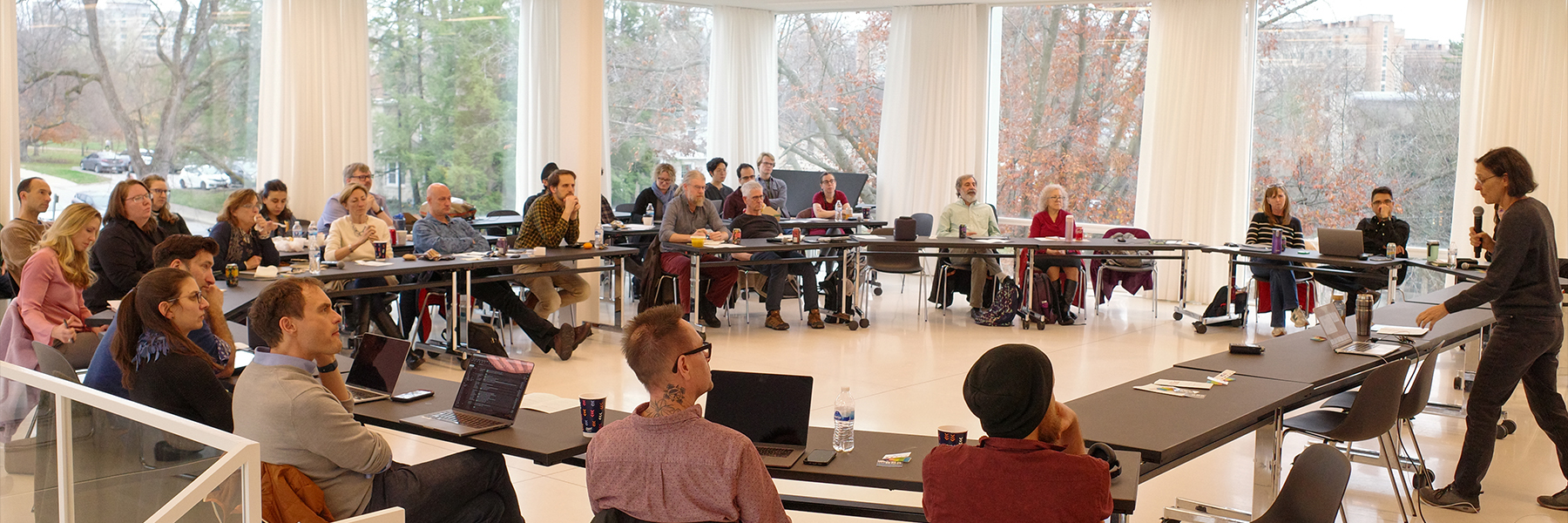
It’s the usual race to the finish at the end of the school year, and I’m not in the lead (as usual). But I’ve been passing significant milestones, grabbing water as I can. One was the recently completed TBS (which stands for “The Bloomington Symposia”), sponsored by the Institute for Advanced Study, the subject of which this year was the title of this post, “Free Speech and the University.” I co-convened this with my colleague Steve Sanders, from Bloomington’s Maurer School of Law.
We had a fantastic line up of participants, which is in the program here. As co-convener, I got to help set the frame on the first day, so after Steve’s framing, I provided mine. I’ll paste the basic outline below.
These kinds of things are never completed, and this event left a lot on the table. I’m hoping we can pick some of those items (artifacts is the concept often used in these symposia) in the coming weeks and months.
An American and a Soviet go into a bar, let’s say, in East Germany, circa 1982, and quickly get into a political pissing match. The American says, ‘We have free speech in our country.’ The Soviet says, ‘The Soviet constitution guarantees freedom of speech to all citizens of the USSR.’ Things are heating up when a Yugoslav comes up behind them, puts his hands on their shoulders, and says, ‘Guys, there’s no argument here. Yes, in the USSR there is official freedom of speech. What you have in the US is freedom after speech.’
[P.S. One of the first amendment scholars in the audience told me she wrote down the story in her notebook for future reference. It’s an old Soviet anecdote, originally one of the ‘Armenian Radio’ genre, for those who might remember.]
I begin with this story because it seems appropriate for our discussions. How and why will become clear in my subsequent comments. I’d like to begin those with a story.
In her 2011 book Cold War Civil Rights, Mary Dudziak offers a compelling account of how the United States’ global competition with the Soviet Union shaped its domestic civil rights agenda. Faced with the glaring contradiction between its democratic ideals and the realities of Jim Crow, segregation, and racial violence, the U.S. government pursued a dual strategy. On the one hand, it enacted federal legislation—most notably, the Voting Rights Act of 1965. On the other, it crafted a narrative: a story of gradual progress, of steady, inevitable improvement over time.
Many of us grew up with that story. It was part of a broader postwar American imagination—one that also told us that liberal democracy would expand, that knowledge and reason would prevail, and that institutions like universities would serve as engines of both.
But if Dudziak is right—and her thesis has proven remarkably durable—then that story was never simply about internal moral progress. It was also about external pressure. It was about how the United States wished to be seen in the world.
And so we are led to a set of difficult questions for our present moment.
What happens when that external pressure recedes? In a post–Cold War context, when the imperative to perform democracy for a global audience has weakened, what becomes of the commitments that once seemed non-negotiable? Was a weakening of federal guarantees for voting rights inevitable? Should we be surprised by the resurgence of voter suppression debates, or by the persistence—and in some cases, intensification—of racial inequality and violence?
These questions do not belong only to political historians. They reach directly into the life of the university.
Because the same period that saw the Civil Rights Movement also witnessed the rise of powerful, intersecting movements—for women’s rights, for free speech, for organized civil disobedience. Many of these movements found one of their primary stages on college and university campuses. Indeed, there was a moment when ‘being on campus’ became almost synonymous with protest, with dissent, with the active testing of the boundaries of expression.
Campuses were not just sites of learning; they were laboratories of democracy.
And this raises a second set of questions: To what extent can we understand the modern idea of ‘free speech on campus’ as, at least in part, a Cold War phenomenon? Did the presence of a clearly defined global adversary sharpen the contours of what counted as freedom of expression? And if so, what happens to those contours when that adversary disappears?
These are among the central research questions that have guided my thinking throughout this year of working with our group of scholars, all bringing their own disciplinary lenses to a shared problem, many from very different areas of focus than the one I just suggested.
Our inquiry does not stop with the Cold War, of course.
If we widen the lens, we see that the struggle over expression in universities is both deeply historical and profoundly global. The earliest European universities emerged under the authority of the Church, bound by doctrinal limits even as they cultivated traditions of inquiry. Over centuries, those institutions evolved into spaces that championed intellectual freedom—yet the tension between authority and expression never fully disappeared.
It surfaces again and again: in dismissals, in court cases, in moments of public controversy. One need only recall the 1940 case of Kay v. Board of Higher Education of the City of New York, in which Bertrand Russell was deemed unfit to teach because of his views on sexuality and religion. Or look beyond the United States today, to ongoing struggles over academic freedom and expression in India, in parts of Europe, in Latin America, in Africa.
These examples remind us that the questions we are asking are not uniquely those of the U.S., nor are they new.
They are, instead, part of a long and ongoing negotiation: between institutions and individuals, between authority and dissent, between the preservation of social order and the expansion of intellectual freedom.
And this brings us to a third thread—one that is perhaps closest to home.
Contemporary universities are extraordinarily complex institutions. They serve students, certainly—but also employers, legislators, professional organizations, alumni, donors, and broader communities. They are shaped by financial pressures, political scrutiny, and shifting cultural expectations.
In recent years, these pressures have intensified. In some contexts, faculty have found their voices marginalized in decisions about teaching and research—decisions for which they are nonetheless held responsible. In others, the very idea of the university as a space of open inquiry has been called into question, sometimes explicitly, sometimes through more subtle forms of constraint.
At the same time, campus life — such as it is — continues to be shaped by the very forces we have been discussing: protest, dissent, and the ongoing redefinition of what counts as legitimate expression.
So we must ask: Is the ideal of the ‘open university’ still viable? If so, in what form? What structures might allow faculty voices to be meaningfully included in institutional governance? How do we define ‘diversity of viewpoints’—and who gets to decide? What is ‘expertise’? And perhaps most importantly, what kinds of institutional arrangements are necessary to sustain freedom of expression as part of a healthy democratic society?
These are not questions that any single discipline can answer.
They require historians and political scientists, legal scholars and sociologists, philosophers, and educators. They require us to develop a shared vocabulary—to ask, together, what we mean by ‘expression,’ by ‘freedom,’ by ‘health’ in a democratic society, and by the role of the liberal arts within it.
That is the work we have begun.
We are fortunate to be undertaking this work here in the context of the Bloomington Symposia and at Indiana University, which has long been a leader in global and interdisciplinary education. Historically (at least) it has also not shied away from the challenges and controversies surrounding free expression on campus. As a large public institution, it sits at the intersection of many of the forces we are seeking to understand.
But institutional resources, important as they are, are not enough.
If there is one lesson to take from the story with which I began, it is that progress is not inevitable. The narrative of gradual improvement—the one many of us inherited—can foster not only hope, but also complacency.
And so perhaps the challenge before us is not simply to describe the current moment — we’re good at description.
What we often have trouble with, like anyone, is moving beyond inherited narratives and toward a more active, collective engagement with the conditions that shape expression in our universities and our society. A tall task.
To start, we’ll need to recognize that the tensions we study—between authority and freedom, between structure and dissent—are not problems to be solved once and for all, but dynamics to be navigated, again and again, with care and with commitment.
We stand a much greater chance of succeeding if we approach this work not in isolation but together. I look forward to our work together.
###

