My “Loving Russia” was published earlier this summer at The Massachusetts Review, with an epigraph from Susan Sontag’s 2000 New Yorker essay “Loving Russia.” Though the essay’s done and out in the world, it’s still something I’m working on, or maybe working through is the better expression. As part of that on-going work, I presented, two days ago or maybe three (the travel has untied my internal clock from its usual anchors) at the International Dostoevsky Society conference in Nagoya, though I admit having been a bit apprehensive not because Japan but because “great Russian writer,” a phrase that tends to stick in my throat at this moment in history.
But the Japanese hosts were impeccable in their organization, the conversations professional and at a very high-level, without the clichés, for the most part, and the cultural baggage that goes with them. And I learned new things, met some wonderful colleagues whose names I knew and work I had read, made some friends, and came away with some writing ideas. I don’t think I’d actually ever been to a conference devoted entirely to one writer, and mostly to one work by that writer. This too was an eye-opening and positive experience. Hats off to the organizers at Nagoya University and across Japan, the North American Dostoevsky Society, and the International Dostoevsky Society.
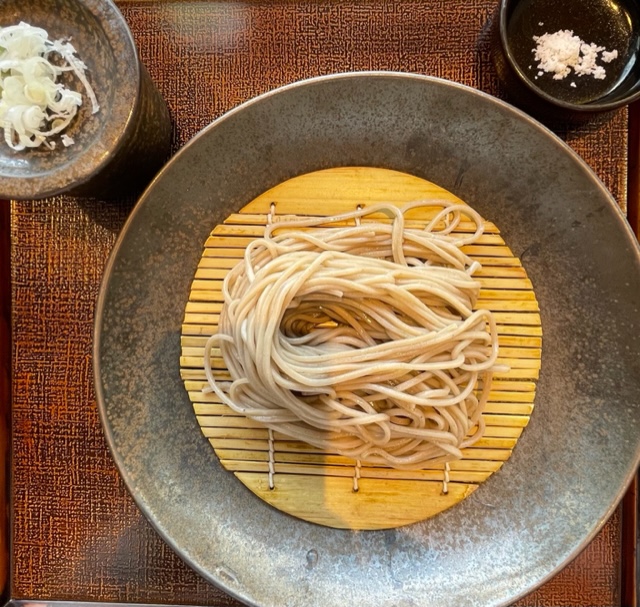
Then I had a little celebratory soba, pictured here, in Osaka, on my way home. That is salt in the upper right corner, by the way, which is something they offer when the soba is really good: to taste the noodles, you don’t dip them in the dipping sauce but rather just lightly touch them on the salt so it sticks to them, and then… it was probably the best soba I’ve ever had.
But Dostoevsky was still with me, partly from before the conference, even more after. Dostoevsky is a problem. While I’ve written on his work in the past — a long chapter in my first book, on his Demons; another chapter in my second book on his Double, and a short piece later in the same book on Crime and Punishment — I’m thinking now that maybe there’s more in me on this, maybe another book.
I had, in fact, wanted to return to an idea that occurred to me while writing The Woman in the Window, but, as with many things that I’ve had ideas about writing, I didn’t know how to go about it at first. It has been stuck now at that I-wonder-how-to-write-it stage for about a decade. Once I’m a little more rested, I hope to be able to decide whether it’s really unstuck or my present unstuckness in time has just created that impression. At that point, I suppose I’ll also have to confront the question of whether I really want to lean into this “great Russian writer” thing, which working on such a project would require.
###
 Russell Scott Valentino