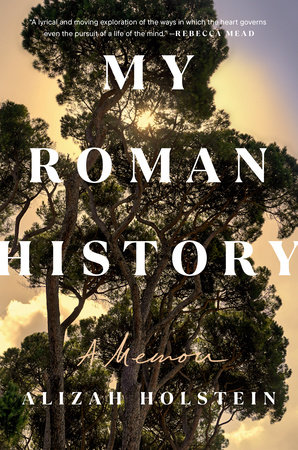
Alizah Holstein’s 2024 book My Roman History: A Memoir (published by Viking Penguin) takes a long view of the author’s journey to a failed academic career as a historian of medieval Roman history. The journey is the main story, the drive and wonder behind it especially, including what otherwise might be esoteric questions of power, politics, and literary and historical references in an eventual (completed) dissertation on Rome in the relatively understudied fourteenth century. I write otherwise because the writing is excellent, the pace and personal detail measured and careful, and the result is a reading experience that kept me going, even as I found some aspects of the story disappointing.
I read it on the recommendation of my friend Robin, one of those thanked at the end of the book in association with the writing programs in which Holstein studied post-PhD, earning an MFA in the International Writing and Literary Translation Program at Vermont College. “Maybe your book on the Adriatic is a memoir,” he suggested, “just with a different kind of scholarship in it.”
The question of whether Holstein’s book could serve as something of a model for me added a research dimension to my reading, questions of how: to construct an authorial persona, to prepare later things by earlier ones, to build up to the set pieces, to include enough of the personal without coming across as self-absorbed, to include possibly arcane aspects of scholarship in an engaging manner, without becoming “the professor.”
One drawback in my experience from the start was the fact that my partner had announced: if you write a memoir, I will not be reading it. This, it turns out, is a major drawback, as she has often been my first and best reader. But just as there are writing techniques that creative nonfiction authors have taken from fiction writing, and sometimes poetry, so too have I sometimes borrowed techniques from literary nonfiction in my scholarly writing. I could certainly steal one or two.
One to consider is the scope. Holstein reaches back and a bit forward. While the focus, and most of the book’s 342 pages, are devoted to her six years training to be a professional historian, she begins with a frame that is a long-before (her in high school, at seventeen) and long-after (a family scene from close to the present), which is very smart and, I think, effective. Besides its grounding, which tells us things like, I’m looking back now just as I was looking forward then, I have an impulsive streak, and I have a character that might make for an interesting narrator, it also sets out insecurities and questions: Why has she so longed for Rome for so long? What has prevented her from ever really getting there “the way she first envisioned”?
There is also, in this opening scene, a ready nostalgia for things lost that were never in fact gained (“For much of my life, I have been trying to get there. And yet I never quite have.” “Roman, though I know I am not, and never will be”), which raises questions about what the author is trying to attain and why. It is a sort of mystery, a desire that somehow, inexplicably, arose inside her at a key moment and then drove her for a good decade towards “it.” What it is, what it was, is part of the mystery.
There are many happy turns of phrase, though I admit that sometimes they feel a little too clever. This might be a result of the form. The chapters have numbers (small font) and thematic or topical names (big font), like “Living Latin,” and “The Holy Roman Alpine Club,” and “If Only I Could Live in their Times.” Then inside the chapters are smaller segments of variable length, from one paragraph to five or six on average. Each chapter, then, is something like a segmented essay, which means that each unit tends to have a beginning, middle, and end, even when it’s fragmentary. Coming up with the feel of an ending after a few paragraphs is what I mean by the form’s possibly creating a cleverness constraint.
For example, when she writes at the end of one mini-segment, “By my senior year of college, I was pursuing a historical question for its potential value for the field rather than for my personal connection to it. Like any scholar worth her salt, I was training my head to lead my heart” (121), I recognize immediately the attraction of the dichotomy’s phrasing but also see its essential falseness. Scholars, when they’ve done things for a long time and sometimes long before that, are often following their hearts as much as they are their heads. Dante’s lungo studio and grande amore are inextricably linked for many of us. Pulling them apart like this makes for a nice line to end a section with but feels a bit like a straw man.
The authentic searching is palpable throughout, and this for me is one of the two primary strengths of the book. Trying to make sense of the past as a trained historian parallels trying to make sense of her own past. These in turn are skillfully sutured to the material of study, both the Roman historical aspects and the personal ones. This makes the writing multi-layered, an effect the author begins developing from the book’s very title.
As a scholar and sometime mentor of graduate students, I could not help feeling disappointment and, sometimes, profound shame at the behavior of some of the author’s teachers, who, it seems to me, failed her many times over. The scene at the famous Italian professor’s home is perhaps the most painful example, though her quite generous imagined post-encounter conversation with him provides some respite.
Her descriptions of Roman places are also highlights. These are careful portraits with depth, again both historical and personal. The magic of Sant’Ivo alla Sapienza, in particular, creates a special kind of longing that she returns to more than once with great effect.
I said there were two primary strengths. The other, which for anyone who might know my interests will come as no surprise, is the loving use Holstein makes of Dante throughout, from the first paragraph, which invokes the “dark magic” worked on her teenage self by The Inferno, to the final chapter, to which she gives the title “Ascent.” For a second I found myself wishing the chapter would have been number 33, rather than 37. But even without this particular perfection, the echoes, interconnections, and evocations feel natural and true. And also quite beautiful.
###
 Russell Scott Valentino