I discontinued my TwiXter account many months ago, but when people on FB mentioned joining Bluesky, I decided to give it a try. So I’m over there @russellv.bsky.social. I post occasionally. It’s fine.
But I did notice quite a few writers and musicians, and writers includes translators and musicians includes amateur composers. That part is nice, even if it’s more of what Cass Sunstein once labeled (in his republic.com) “the daily me,” meaning the general filtering out of things I’m not interested in. It’s a pernicious, undemocratic thing. I don’t know how we’re ever going to fix it. People want that they want. Now they can get just that and nothing else.
On the flipside, one of the nicer things I came across was Bandcamp, which I might have heard of earlier but didn’t really register it. I took a look and like it a lot, maybe better then any of the other streaming platforms I’ve tried. The interface is attractive, it’s a lot more flexible than any of the others, and it appears to be much better (including financially) for independent musicians.
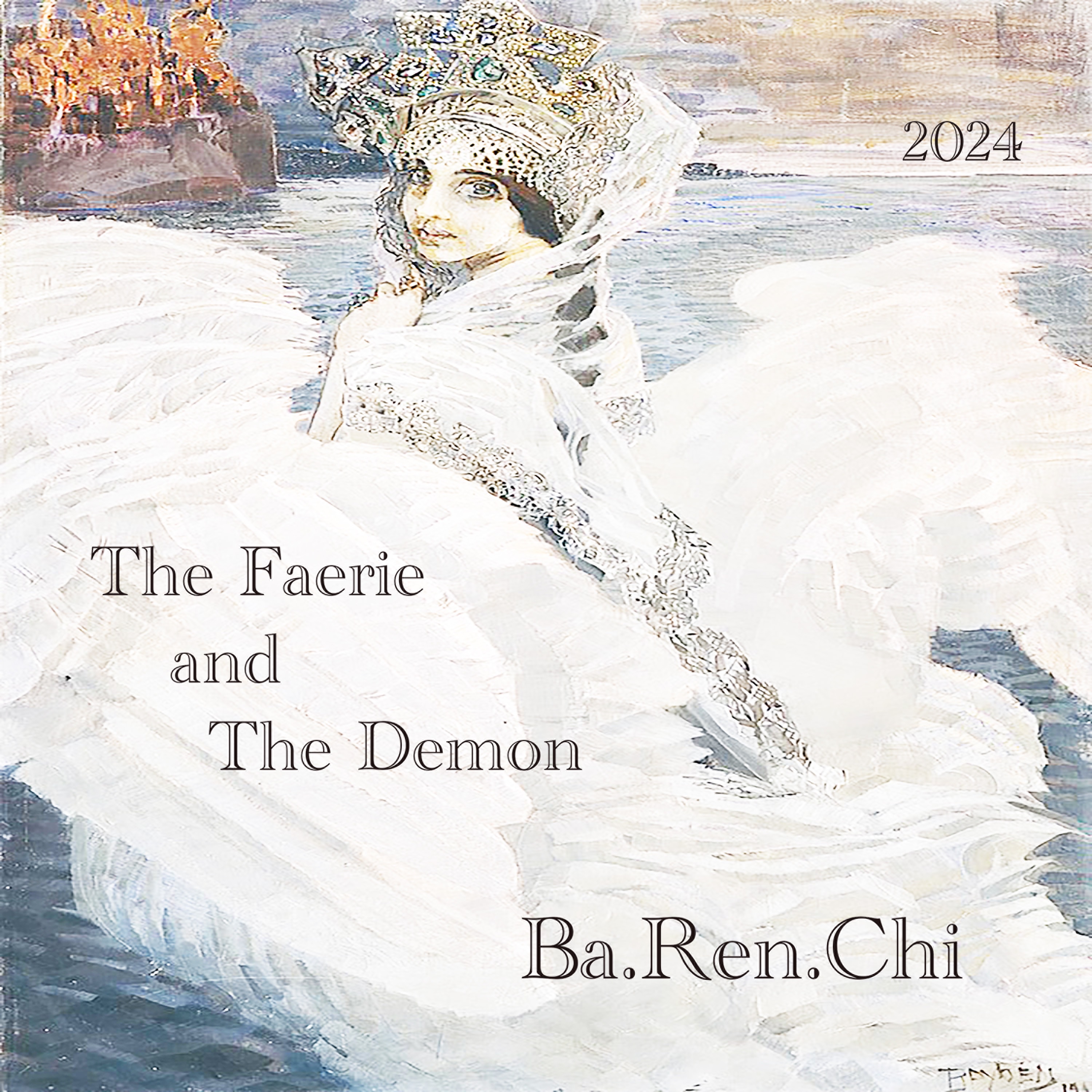
In deciding to give it a try, I went back to an earlier composition, one that has a lot of plays elsewhere, and give it a new look, some revisions to the scores, and some tighter and more even mixes. It is also the most conceptually coherent of any of the things ba.ren.chi has put out.
Here’s the description:
The Faerie and the Demon is a composition of pure fantasy comprised of three movements: “Forest Dance,” “Sunrise and Caravan,” and “Escape to the Sea.”
“Forest Dance” announces the opening scene, then introduces the faerie and friends playing in the natural surroundings. They are interrupted by the demon’s dramatic entrance and dance, only re-emerging from hiding after the demon has stormed off. The solo violin takes the theme across time signatures with plenty of movement, especially once the drums enter with a feel of three against two. A hint of the sinister in the final chords serves as the lead to the final segment.
The middle movement, “Sunrise and Caravan,” opens with the shimmering sunrise, slips into a mournful interlude, and then becomes all motion across a desert setting to the end.
The final movement opens with a percussion segment — keyboards, earth drums, orchestra percussion section, but also gamelan, gong, and brushes — and then leads to a latinesque section featuring flute, base, and congas, which alternates with something that feels more martial, building to the finale, which is a bit wild.
And a pic of the album cover, which I took from a painting called Swan Princess by Mikhail Vrubel.
###
 Russell Scott Valentino